



Pearson Attenuators
- Brand
- Pearson
- Origin
- United States
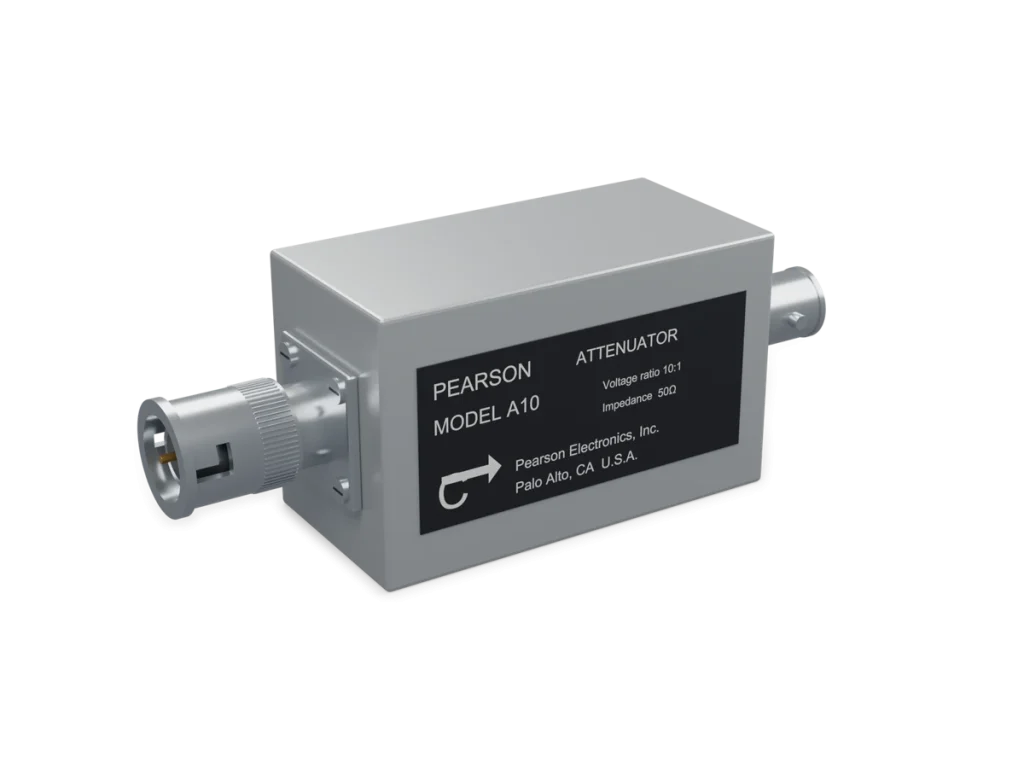
Signal attenuation between a current transformer and a measurement instrument, selected to suit the instrument input.
Key specification options
- Voltage ratio
- 10:1(–20 dB) / 5:1(–14 dB) / 2:1(–6 dB)
- Maximum peak voltage
- 500V
- Bandwidth ±dB
- DC-100MHz / DC-70MHz±1%
- Midband
- ±1%
- Interface type
- BNC
Product design
Pearson attenuators connect a current transformer output to the receiving instrument and reduce the signal amplitude at the input. They do not sense current or replace isolation. Include their attenuation in the instrument display settings or subsequent conversion.
Measurement and application
An attenuator reduces signal amplitude between a current transformer output and the receiving instrument. Select it as part of the complete measurement chain, together with the sensor and oscilloscope.
Selection and connections
Check the sensor output, instrument input impedance and connectors. Account for attenuation in the instrument settings or data conversion so the displayed result represents the measured signal. An attenuator is not an electrical isolation device.
Models & specifications
Pearson Attenuators
Model selection
| Model | Voltage ratio | Maximum peak voltage | Bandwidth ±dB | Midband | Interface type |
|---|---|---|---|---|---|
| A10 | 10:1(–20 dB) | 500V | DC-100MHz | ±1% | BNC |
| A5 | 5:1(–14 dB) | 500V | DC-100MHz | ±1% | BNC |
| A2 | 2:1(–6 dB) | 500V | DC-70MHz±1% | ±1% | BNC |
No matching models. Try another keyword or contact us.